

Tech Credit Fund has integrated Connectivity Credits as a verified impact mechanism, giving fund investors a real-time, independently verified view of the social impact generated by the ISPs it finances.
Backed by Solcon Capital, Tech Credit Fund is one of Africa's leading debt funds, dedicated to lending to black-owned SME internet service providers (ISPs) that are expanding connectivity access while building sustainable businesses. An initial group of ten SME ISPs will earn Connectivity Credits for every impact institution they connect (starting with schools), generating digital proof for each day of meaningful connectivity they provide.
This initiative is delivered in collaboration with UNICEF Digital Impact and Giga (a joint UNICEF-ITU initiative), who worked with Tech Credit Fund to establish and manage the integration of Connectivity
Credits into their portfolio. The result is an ongoing, real-time record of verified performance that gives investors the kind of independent, data-backed evidence of impact that institutional capital increasingly demands — and that further strengthens Tech Credit Fund as a leading vehicle for attracting new investment in connectivity in South Africa.
Activating capital for SME ISP expansion in South Africa
Expanding connectivity access in South Africa depends heavily on SME ISPs' willingness to service underserved communities. Large ISPs often bypass these areas: limited local knowledge and operations, unique monetisation challenges, and thinner margins push them toward 'known' areas. SME ISPs, by contrast, are frequently well-placed to serve townships, rural towns, and peri-urban communities — they have the community relationships, agility, and flexibility to succeed.
South Africa has huge potential to expand meaningful internet access through thousands of SME ISPs in the country, yet the majority of ISPs struggle to access the capital needed to grow. Tech Credit Fund was established to address this structural gap: the persistent underfunding of capable, black-owned ISPs that are essential to extending last-mile connectivity where it matters most. While significant investment has been made at the backbone and national network level, those gains have not translated equitably to the last mile.
Founded by chairman Andile Ngcaba, Tech Credit Fund deployed R10 million across its first ten investments in Q1 2026 — including TOGIT, a youth black-owned provider in Mpumalanga, and AdNotes, a fully licensed operator serving KwaZulu-Natal using TV White Space technology.
How impact reporting mobilises capital
For impact-focused funds, robust impact reporting serves three distinct functions: it meets existing investor requirements, attracts new investors with credible proof of outcomes, and supports the case for capital recycling — multiplying the total impact that can be financed. This means that credible impact reporting isn't just a compliance function — it is a direct lever on how much capital can ultimately flow toward expanding connectivity access.
Impact investors increasingly want assets that go beyond self-reported outcomes. They want verification and comparability across a portfolio — Tech Credit Fund is demonstrating how Connectivity Credits provide both.
Connectivity Credits as verifiable, standardised impact records
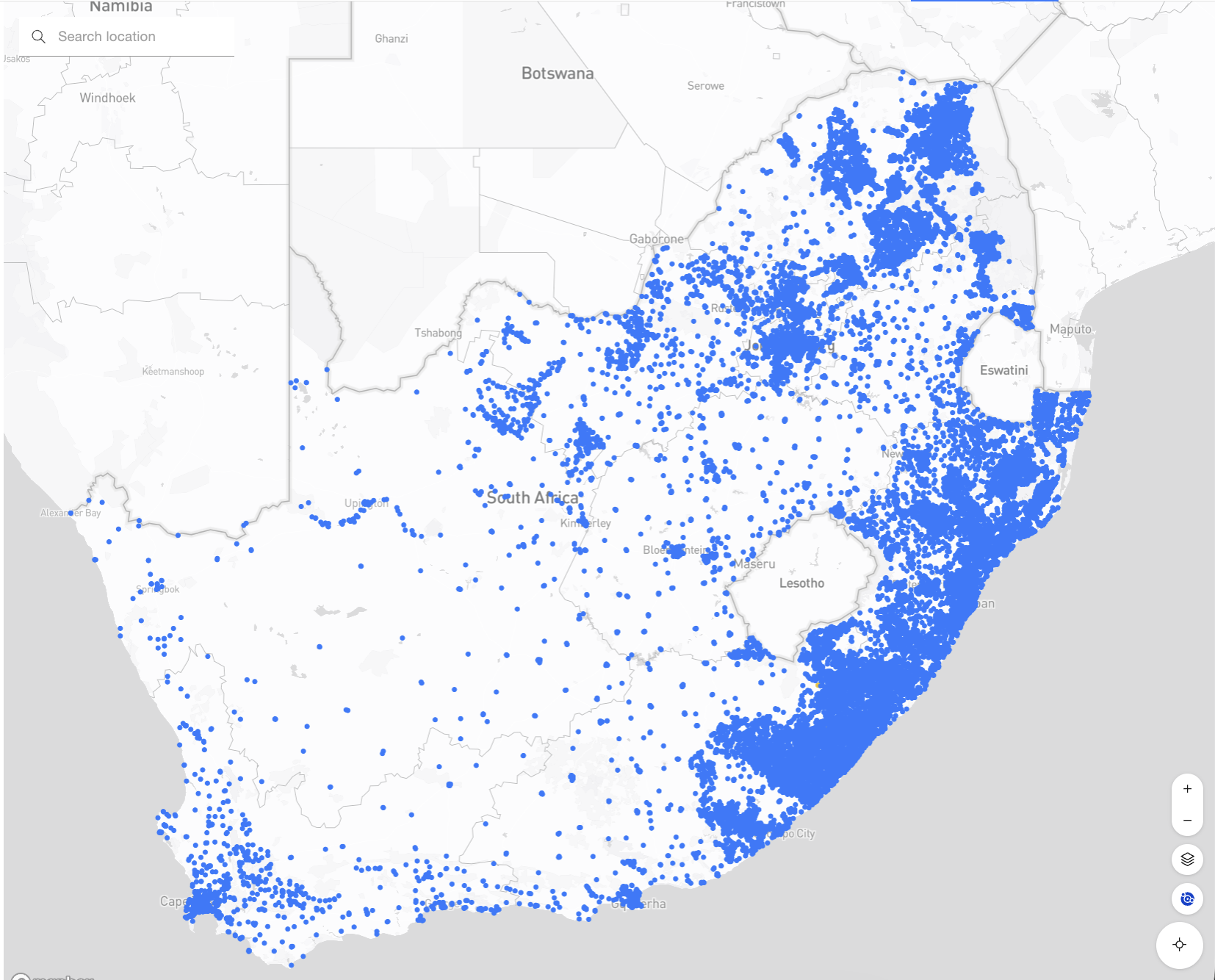
As part of its first cohort, Tech Credit Fund has onboarded its ten SME ISPs to use Connectivity Credits. Whenever an ISP connects a school, they install GigaMeter — an open-source, real-time connectivity monitoring app — on computers at the school. The app runs four speed tests per day and a ping every fifteen minutes, continuously verifying speed, uptime, and latency. For every day an ISP delivers connectivity above 20 Mbps — the ITU-defined threshold for meaningful connectivity in schools — a Connectivity Credit is generated and assigned to that ISP.
Credits accumulate over time, building a continuous, verified track record of delivery for investors rather than a single point-in-time snapshot at installation.
Connectivity Credits provide comparability across portfolios
For investors managing a portfolio of ISPs across multiple regions, comparability is essential. Without a common unit of measurement, it is impossible to assess whether one ISP is generating more impact than another, or to aggregate impact meaningfully at the fund level. Connectivity Credits solve this by providing a single, standardised metric that works across any school, any ISP, and any geography.
While ISPs earn one base credit per day of meaningful connectivity, that figure is multiplied by a Connectivity Credit score — an impact score in line with UNICEF methodology — reflecting the number of vulnerable children in the surrounding area, based on population density and relative wealth index. This means Tech Credit Fund's impact reporting reflects not just coverage, but depth — rewarding the connections that matter most from an equity standpoint.
Looking ahead — a first step towards a new asset class
Tech Credit Fund is the first debt fund to integrate Connectivity Credits as a verified impact unit — establishing a new standard for how social outcomes can be measured, reported, and ultimately embedded into fund structures. Based on this first step, there are multiple pathways through which Connectivity Credits can further mobilise capital for impact:
- Integrating Credits into fund financial structures — funds and LPs may choose to tie Credits directly to the financial terms offered to investees: better repayment conditions, lower interest rates, or
increased capital recycling thresholds, all linked to verified impact performance.
- Access to complementary incentives — Credits are already used in other implementations to give ISPs access to discounted backhaul infrastructure. As this expands, Credits could simultaneously unlock both
cheaper capital and lower infrastructure costs — creating compounding commercial advantages for ISPs delivering impact. At the same time, infrastructure companies (InfraCos) benefit from growing demand on
their networks, and investors benefit from faster portfolio company growth.
- A new asset class and marketplace — as Connectivity Credits become recognised as a standardised impact unit with a transparent, auditable record, they begin to exhibit the properties of a financial asset: verifiable, quantifiable, and comparable. This creates the conditions for investable impact: where funds can use Credit track records to attract concessional capital, where investors can assess ISPs using independently verified performance metrics in addition to traditional financial statements, and where a strong Credit record becomes, in itself, a form of financial collateral. The Credit becomes a bridge between verified social performance and an investable impact asset.
Tech Credit Fund has taken a milestone first step — the first fund to put Connectivity Credits at the centre of its impact reporting, and in doing so, pointing toward a future where verified connectivity delivery is not just a social metric but a financial one. As more funds follow, the Credits that ISPs accumulate today may form the foundation of an entirely new class of impact-linked assets for tomorrow.