

USF Malawi, the Malawi Ministry of Education, Science and Technology, Malawi Communications Regulatory Authority, UNICEF Malawi, Giga, and unconnected.org have partnered to demonstrate how Connectivity Credits can enable sustainable financing of school connectivity in Malawi.
ISPs earn Credits for connecting schools and exchange them for access to discounted LEO satellite backhaul — provided through unconnected.org's partnership with Starlink.
This access to lower costs enables ISPs to grow their business in areas which may not otherwise be business viable and make profits, on the condition they connect schools.
As of end of May 2026, three ISPs — Converged Technology Networks, Access Communications, and Dandemutande — have connected 51 schools, with new ISPs and schools joining on a rolling basis.
The need for sustainable models for school connectivity in Malawi
Malawi has 9,442 schools. Only 14% are connected to the internet – connectivity rates are ~7–10% in large rural districts compared to 20–30% in urban areas. Of the schools that have already been connected through government funding and donor grants, the majority say they could not sustain connectivity costs on their own.
As Malawi prepares for major school connectivity expansion through the World Bank-financed Digital Malawi Accelerate Project (DMAP), establishing models that remain viable after grant funding expires is critical. Connecting schools is one challenge; keeping them connected is another.
The Universal Service Fund of Malawi plays a central role in this effort. USFs are government-mandated mechanisms, typically funded by levies on telecoms operators, designed to finance connectivity for underserved communities and institutions. Around the world, USFs face a common challenge: they can fund the initial connection, but have no reliable mechanism to ensure schools and communities stay online once the grant period ends. Building sustainable, commercially viable models — rather than perpetual subsidy — is the defining challenge for USFs everywhere.
Discounted backhaul as a sustainable incentive for ISPs to connect schools
One approach is to give ISPs access to cheaper backhaul — on the condition that they connect a school. Especially for small and medium sized ISPs, this is highly relevant, as on their own they don’t have the volumes to negotiate cheap backhaul - but as an aggregated group it is possible.
Unconnected.org first demonstrated this approach in Malawi in 2023. The current pilot builds on that experience, refining the approach together in coordination with government stakeholders.
The model works as follows: ISPs receive a Starlink dish and 200 Mbps of monthly capacity at a discounted rate. They must provision the school with at least 20 Mbps; the remaining capacity they sell commercially — as wifi vouchers, or to local businesses like pharmacies — generating enough revenue to make the school connection commercially self-sustaining. In Year 1, the discounted rate is further subsidised through grant funding. From Year 2 onwards, the ISP continues at the discounted rate for as long as the school remains connected.

The key feature of this model is that the backhaul discount acts as a continuous hook: ISPs retain the commercial advantage only while they keep schools connected. This is what makes it structurally different from a one-off grant — there is no single payout to walk away from. The ISP's ongoing business economics depend on maintaining the school connection.
This alignment of incentives is good for everyone: ISPs benefit from lower costs and new revenue streams; schools receive free internet; governments and donors get a self-sustaining model that doesn't require indefinite subsidy; and backhaul providers see growing, recurring demand on their capacity.
Connectivity Credits as an accountability and verification mechanism
Connectivity Credits make this model operationally robust for all parties.
ISPs earn a Credit for every day they keep a school meaningfully connected. Whenever an ISP connects a school, they install Giga Meter — an open-source, real-time connectivity monitoring app — on computers at the school. The app runs four speed tests per day and a latency ping every fifteen minutes, continuously verifying speed, uptime, and latency. For every day an ISP delivers connectivity above 20 Mbps — the ITU threshold for meaningful connectivity in schools — a Connectivity Credit is generated and assigned to that ISP.
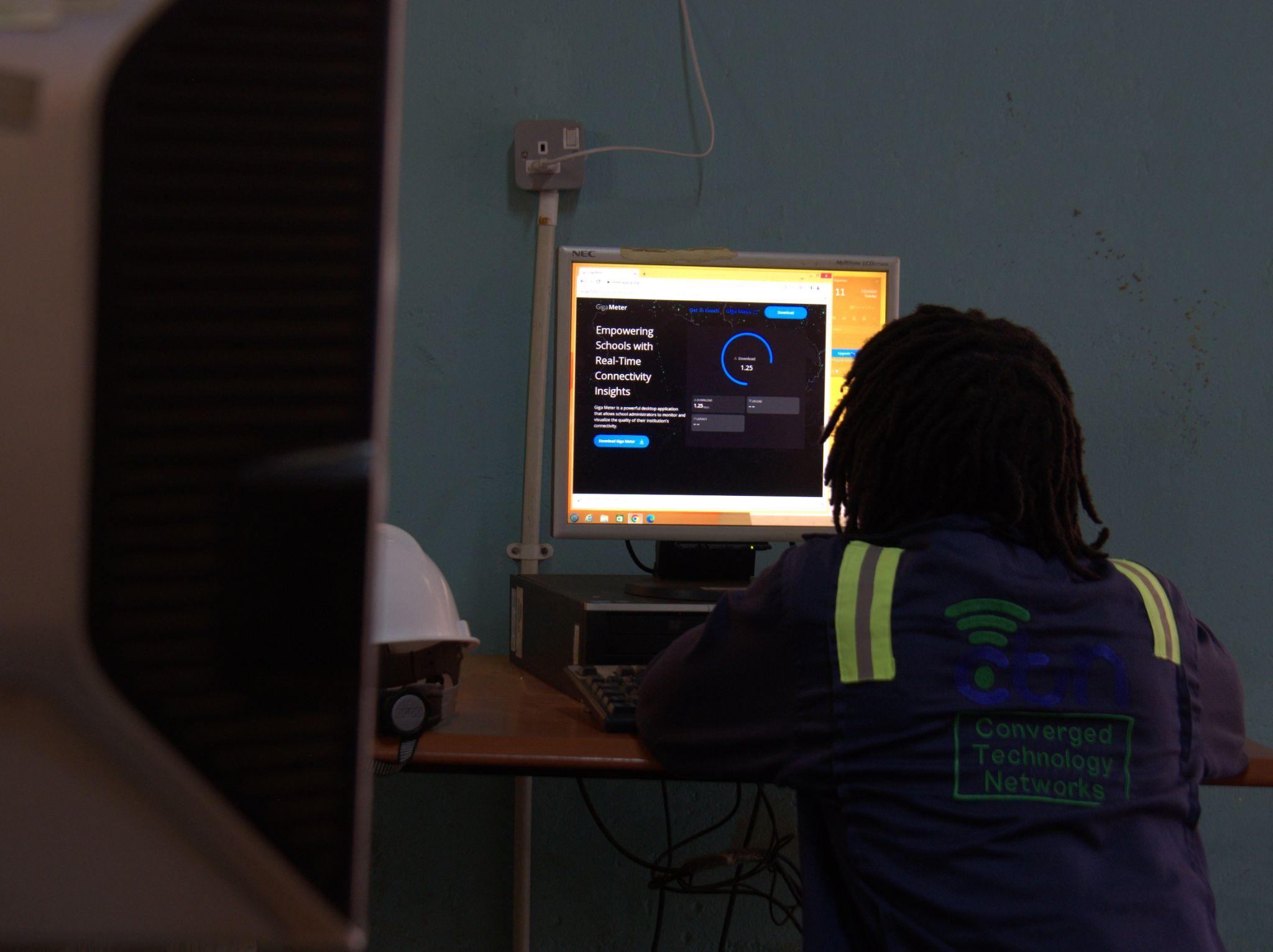
At the end of each month, Credits are exchanged for the backhaul discount. An ISP that fails to keep the school connected is at risk of losing its discounted rate and would revert to commercial pricing.
This makes Credits an accountability layer for all parties: funders, infrastructure providers, and government can see in real time whether ISPs are fulfilling the impact condition that justifies their subsidy and discount. The pilot has already shown this in action: ISPs have proactively upgraded their service and customer-premise equipment at schools to meet the required performance threshold — investment they would have had no incentive to make without the Credit mechanism.
School selection process as key to unlocking ISP and government alignment
The pilot has also served as a proving ground for how schools are selected — a process that matters more than it might seem.
ISPs are investing their own capital to connect schools, so they will only do so in areas where they already see commercial opportunity. Giving ISPs a say in which schools they connect is not just a concession — it's essential to keeping them committed over the long term. An ISP that felt compelled to connect a school it didn't choose is far more likely to quietly deprioritize it when things get difficult.
But completely unconstrained choice creates its own problems. ISPs are driven by business logic, not coverage data. Left to select freely, they might choose schools that are already connected, schools which don’t have the necessary conditions to make use of the internet (like power or devise), or schools already planned for government-funded rollout — producing fragmentation, duplication, and the kind of double-counting problem familiar from carbon credit markets.
In Malawi, the pilot resolved this with a two-track system: USF shares a longlist of schools it has already invested in — equipped with ICT labs, devices, and electricity, but lacking ongoing connectivity — from which ISPs can choose. ISPs can also propose their own sites, which are cross-checked against UNICEF collected data and confirmed against MoEST's national rollout plans. ISP choice is preserved; government alignment is maintained.
This also surfaces a useful pattern for resource coordination. When ISPs select from the USF list, they're extending value from an investment government already made. When ISPs self-select, they often find schools that NGOs have already equipped — like Hardy Bunch in Kasungu district, which provided devices and power — leaving connectivity as the only missing layer. Connectivity Credits provide exactly that layer, without duplicating what's already there.
Looking forward: a replicable model for Universal Service Fund spending
As one of the least developed countries and a landlocked country (meaning high backhaul costs), Malawi represents one of the most challenging settings for establishing sustainable models for school connectivity – and is therefore a particularly important reference point for others.
This pilot offers a blueprint that Universal Service Funds around the world can adopt for transitioning school connectivity onto a sustainable footing: combine conditional backhaul discounts with real-time performance verification, give ISPs a commercial reason to stay engaged, and use Connectivity Credits as the accountability layer that ties the whole system together.
Going further, Connectivity Credits could offer USFs flexibility to redefine how they currently create impact. In addition to USFs directly funding connections, telecoms operators could contribute to the USF by purchasing Credits — effectively paying for verified evidence of connectivity already delivered by ISPs in the field. Infrastructure providers could contribute discounted backhaul or last-mile capacity and receive Credits in return, satisfying their USF obligation through verified impact rather than upfront capital transfer. This gives regulators and governments a more flexible, outcome-oriented tool for managing universal service obligations — one that rewards performance rather than just spending, and that can attract a broader range of contributors to the task of connecting the unconnected.
Phase 2 is already being finalized, with an expanded group of infrastructure companies and financiers continuously joining the initiative.